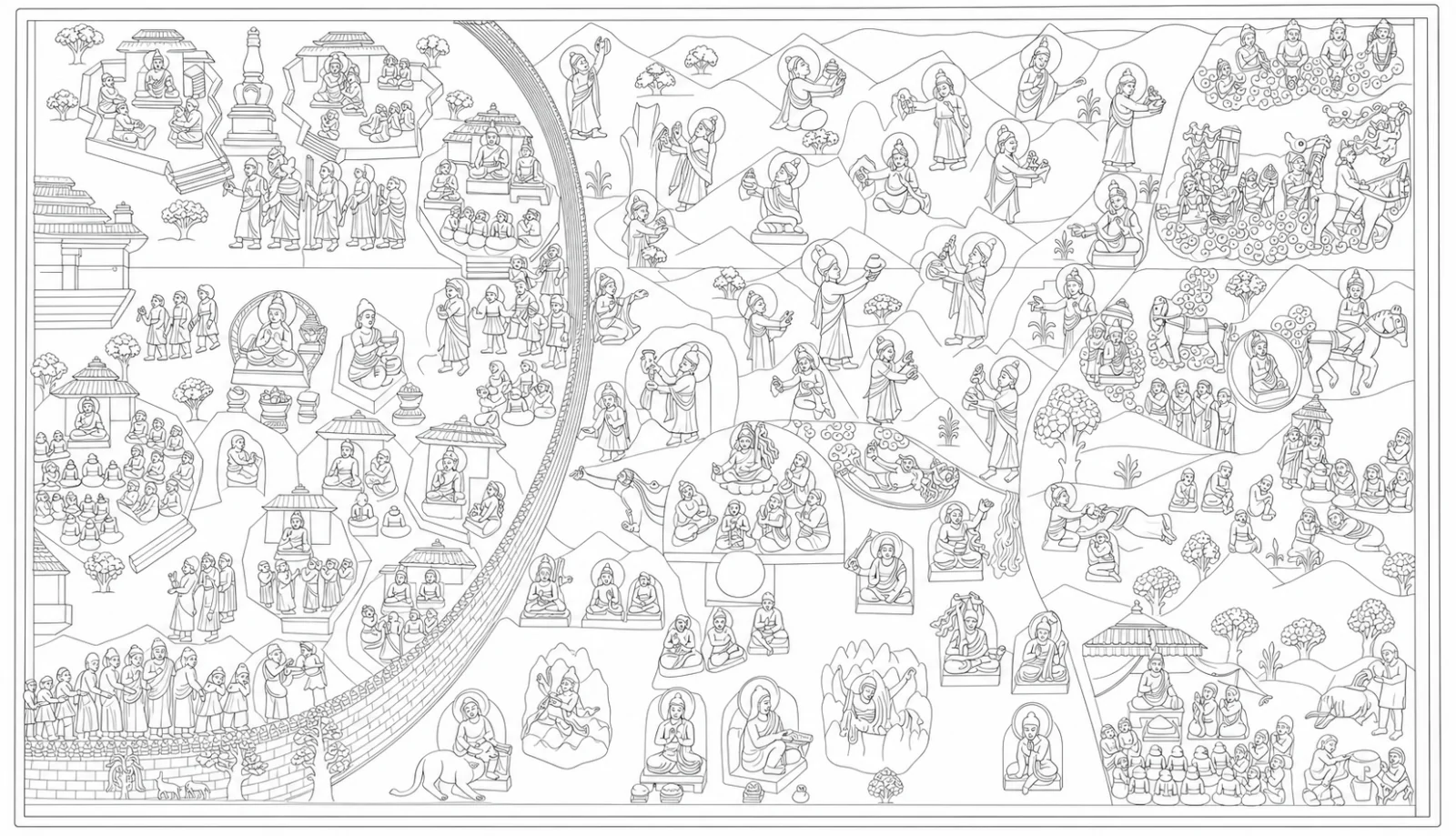
9A · Turning of the Wheel of Dharma
We, Master and Abbot, again conferred, and decided to remain.— The Wish-Fulfilling Tree
I could foresee all those young Tibetans of noble birth
Who should be assembled, and we taught them to translate.
From among this multitude, one hundred lotsāwas emerged,
Including Ka, Chok and Zhang and, foremost of all, Vairocana.
I myself led the translation of the outer and inner tantras,
While the Abbot was in charge of all aspects of Sūtra and Vinaya.
Since the basis for the Dharma is the precious Sangha,— The Wish-Fulfilling Tree
Eleven hundred Tibetan youngsters then took the vows of monks.
We taught them the names of each and every Indian master,
And sent a hundred lotsāwas off to the land of India.
One hundred great paṇḍitas were invited to Tibet—— The Wish-Fulfilling Tree
Vimalamitra, Buddhaguhya, and others of their kind.
And so, in the temple—paṇḍitas, lotsāwas, Abbot and Master—we took our seats
Upon beautiful and lofty thrones, all wrapped in rich brocade,
And we were served the finest treats and offered maṇḍalas of gold.
In order for Tibet to be self-reliant and to have the Dharma flourish in the land, the king is advised to educate young Tibetan boys as translators. Some intelligent boys are brought before the king and the two masters. Shantarakshita tests the children by asking them to repeat the phonetic sound of India after him but the children's pronunciation is nothing like his! The king despairs but Padmasambhava reassures him saying that the Buddha's three main disciples, Ananda, Maudgalputra and Shariputra are reborn in Tibet. He goes on to say that they will be the first translators who in turn will educate more translators. With his wisdom eye, Padmasambhava locates the three boys born into three different families. Trisong Deutsen personally invites the boys to Samye monastery where they are tutored, and they pick up the language of India without difficulty. These earliest lotsawas (translators) were Kawa Paltsek, Chokro Lui Gyaltsen and Jang Yeshe De along with the learned Vairotsana.
The wheel of the Dharma is set in motion with the creation of the sangha of the first seven Tibetan monks at Samye—a monastic tradition of great importance to the flourishing of the practice and teaching of Buddhism.
Brilliant minded, intelligent Tibetans are enrolled in the translation program, and while studying the languages, they are also encouraged to study and realize the practices of the Vajrayana teachings. For this purpose, they travel to different parts of India and the subcontinent to study under learned and accomplished masters.
Indian pandits start coming to Tibet on the invitation of Trisong Deutsen to help in the translation of the texts and to expound the Dharma. The first to come to Tibet is Vimalamitra of Western India, followed by more pandits from various parts of the Indian subcontinent, totaling to about 100 learned men. Likewise, 100 Tibetan lotsawas are sent to India to study.
9B · Transmission & the Hiding of the Sacred Terma
It was then that I, the Lotus Master, had a realization:— The Wish-Fulfilling Tree
"Here in Tibet, all the teachings of Sūtra and Tantra,
And of the outer, inner, and innermost Vajrayana,
Have been studied, contemplated, and practiced, and siddhi signs achieved.
Yet the essence of them all, an indispensable teaching—
The Ocean of Dharma, the Gathering of Transmitted Precepts
I must now with care bestow upon the king and disciples."
At that very same moment, the king and the three princes
Requested me to give it, in Chimphu Cave, in the expanded way.
Padmasambhava's most famous disciples are the Tibetan King and Twenty-five disciples. They met at Chimpu Hermitage and received many teachings from the master. Each of them practiced according to the instructions given and attained great mastery over their particular practice. At the time of passing away, there are those who dissolved into the body of light and yet others who displayed rainbow bodies and other miraculous signs of their spiritual maturity. In these myriad ways, the mahasiddhas of Tibet, the highly realized male and female disciples, exhibited and displayed varied signs of accomplishment in their spiritual practice. And throughout the land of Tibet, Padmasambhava made popular the tradition of mountain hermitages along with the monastic institution of Samye.
After this, I wrote down all the profound Dharma teachings— The Wish-Fulfilling Tree
In five kinds of writing upon scrolls of five kinds of material,
And inserted it in caskets, extraordinary and wondrous.
In Lhasa, and in Samye, Yoru, and Tramdruk,
At the Border Taming and Further Taming Temples,
At the Sheldrak Cave of Yarlung and the Lhodrak Cliff of Kharchu,
At the Yangdzong Fortress of Drak, and in Dawaphuk Cave at Yerpa,
In Yamalung Valley, and Zabu Valley in Tsang,
At Mount Trapzang and at Riwoché in Tsang,
On Lapchi's snowy range and Yolmo's snowy ridge,
At Namkechen and the eight sites of Bhutan,
At Tsari Gyala and the holy site of Sengdam Buwo,
At the extraordinary Drakar Cliff of Tidro,
And at the twenty-five sacred places of Upper and Lower Kham—
Five for awakened form, five for speech, and five for awakened mind,
Five for qualities and five for the awakened activities—
At all these places I practiced, consecrating the sites,
And concealing countless treasures there, both major and minor.
Assisted by his heart-disciple Yeshe Tsogyal, Padmasambhava conceals the teachings in a great variety of ways across the entire land of Tibet and beyond. While concealing them, he makes aspirations and prophecies of their revealers. Padmasambhava transmits many of these concealed teachings to Yeshe Tsogyal, and it is she who records them down in different writing styles, including the symbolic language of the dakinis. While concealing these teachings in rocks, caves, crags, lakes as well as in space, Padmasambhava would appoint a Dharma Guardian to be the terdak, the keeper of the terma, until the right person comes along at the auspicious time.
9C · Departure from Tibet — Mangyul Gunthang Pass
Then I declared, "Our teacher Śākyamuni Buddha,— The Wish-Fulfilling Tree
In The Sūtra of Predictions in Magadha, spoke these words:
'The rākṣasas will pour out from the lands of the southwest;
They will invade and extinguish this Jambu continent.'
My work for the Tibetans, in my direct form, is now complete,
So I must head southwest now, to tame the rākṣasa ogres."
When the prince heard these words,— The Wish-Fulfilling Tree
He cried out, deeply saddened,
And tried to dissuade me from departing.
Out of kindness then, and to benefit the Tibetan people,
I predicted representations of my body, hid treasures to represent my speech,
And entrusted my heart-realization to predestined heirs.
As I explained this point, the prince's sadness disappeared,
And so again I made ready to set off for the land of the rākṣasas.
Everyone escorted me to the mountain pass of Mangyul,— The Wish-Fulfilling Tree
Where I gave my final testament to the prince and Tibetan people,
Along with thirteen pith instructions for clearing away obstacles
And protect your descendants, in the form of a prayer,
And the inner sādhana with its many applications.
These were concealed at Khala Rongo in Mangyul.
All those not present then, those unable to meet me in person, all beings of times to come,— The Wish-Fulfilling Tree
Should study and recite this, my story of liberation.
Memorize it to perfection and understand it to its depths!
When you read this biography during your six sessions,
Bring me to mind, then call upon me in this way.
At the pass of Gunthang in Mangyul unfolds the story of the Tibetan people's separation from Padmasambhava. As Padmasambhava speaks, the young king listens attentively, 'The cannibal savages of Chamara are about to spill out of their island into Jambudvipa, bringing about the extinction of the entire human race. My time to benefit Tibet in a physical body has come to an end. Besides me, there is no one else to do it, therefore I need to go to the land of the rakshasas.' The young king, Mutig Tsenpo, is devastated. He feels discouraged for Tibet if the master leaves and he expresses his sorrow to Padmasambhava. 'Father king has passed away. The Guru of Uddiyana departs. Mutig Tsenpo is abandoned in Tibet. The happiness of the Tibetan people has come to an end. Now whom can I trust?' A great cry emanates from the young king and he faints.
Padmasambhava quickly revives him and takes the king's head onto his lap. With great compassion in his heart for the young king, Padmasambhava reassures him, 'In reality, I am beyond these concepts. For those with faith, I have never departed. For those with faith, I will appear in reality and teach. My compassion is swift and has great strength. Do not be distressed, Divine son, ruler of Tibet!'
In the sky, celestial gods and goddesses have appeared to escort Padmasambhava. Mounted on his divine horse, from the Southwestern direction, Padmasambhava turns to look back to the Tibetans one last time, and he speaks, 'Listen to me, Tibetans. I am now leaving. You should also go back now. If you are trapped in the worldly samsara, the seed of Dharma will not sprout within you. Practice the Dharma and follow me.' And with these words, he sends forth a light ray of immeasurable loving kindness.