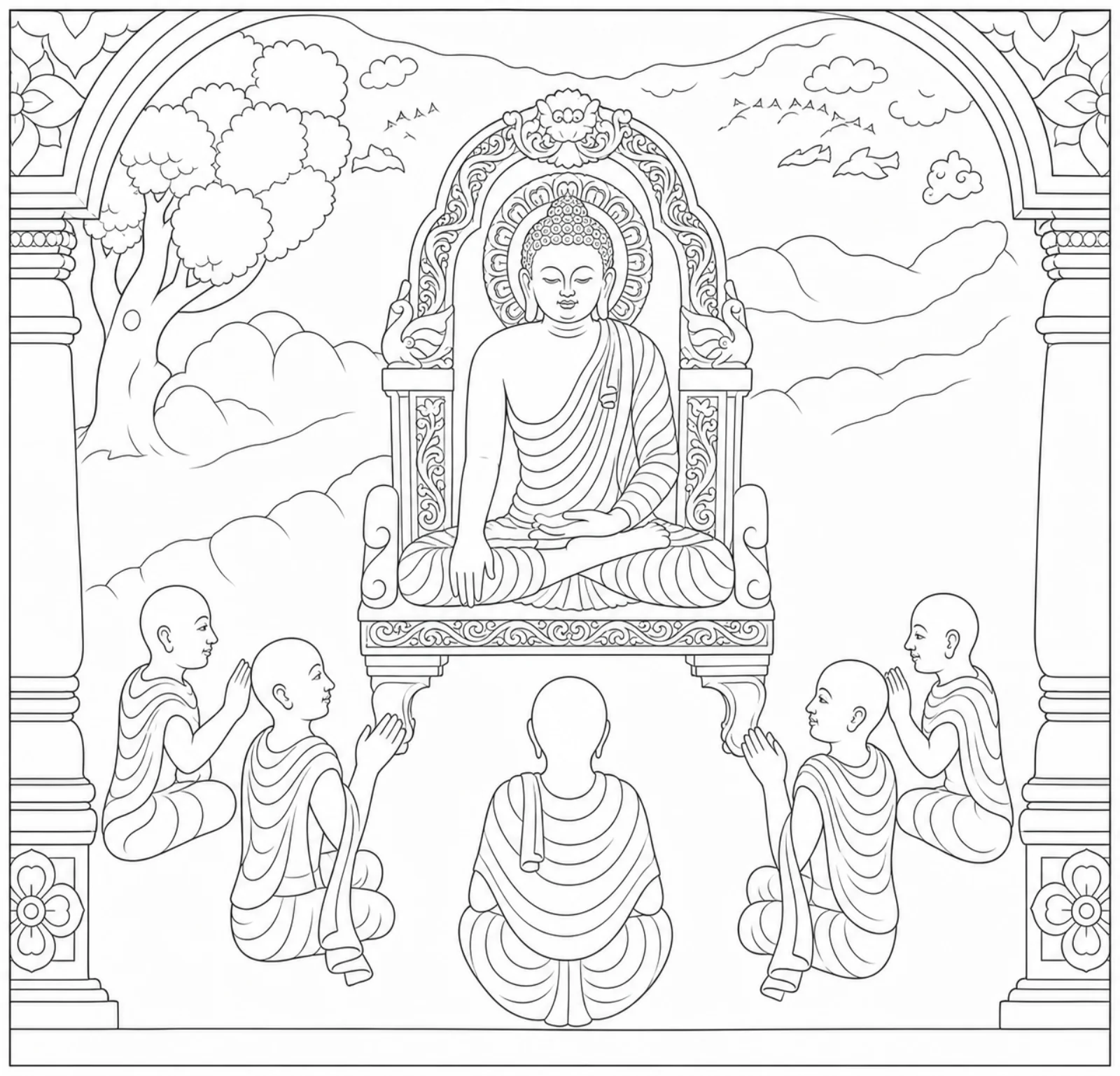
The Buddha delivered his first sermon at Deer Park in Sarnath, near Varanasi, following his enlightenment. He taught the Four Noble Truths and the Eightfold Path to his five former ascetic companions. These five became his first disciples and began to form the bhikshu (monastic) sangha. At the outset of the discourse, the Buddha said that these two extremes should be avoided: Indulgence in sensual pleasures and the Practice of self-mortification. The Buddha expounded the Middle Path which he discovered and which forms the essence of his teaching.
The Four Noble Truths: The noble truth that life involves suffering. The noble truth that suffering arises from craving. The noble truth that suffering ends with the removal of craving. The noble truth that there is a way to the end of suffering through the Noble Eightfold Path.
From the Karmaśataka Sutra: “Monks, there are two extremes toward which renunciants should not tend. You should not draw near to nor even approach them. What are they? They are the tendency toward seductive luxuries, which for city dwellers have become customary and for ordinary people a habit, and the tendency toward self-inflicted hardships, which are a form of suffering, do not belong to the noble Dharma and are in fact harmful. For those who keep their distance from these two extremes, there is a middle way that fully enlightens, passes beyond all sorrow, gives rise to the eye of wisdom, and brings true peace. What is this middle way? It is the eightfold path: right view, right understanding, right speech, right action, right livelihood, right effort, right mindfulness, and right meditation.”